
Is everybody a birder now?!
Plus, somebody (correctly) told me I was very wrong, a pathetic fate for London, and a surprising wine destination

Before we dive into this week’s newsletter, I wanted to take a minute to promote a project I worked on at National Geographic. It’s our first-ever Crash Course. This one is on the American Revolution to help readers refresh their memories in time for all the America 250 celebrations! I hope you’ll check it out.
Among the myriad challenges of being an adult that I could not have conceived of as a child is having to come to terms with who you are not.
Despite my love of nature, I am not a camper. I am not disciplined enough—nor is my day-to-day interesting enough—to be somebody who maintains a journal. I have difficulty finding literature whose main merit is being challenging to be worthwhile. I’m not creative enough to see blank spaces and fashion something out of them. So, no novelist or interior design future for me. Architect seems like a lot of work, and I don’t care enough about winning to be a good businessman.
And, I must admit, that I don’t enjoy birding.
This multi-billion-dollar industry keeps popping up, though. According to the U.S. Fish & Wildlife Service, 96 million Americans identify as birders. (I call b.s. on that stat.) Last year, Amy Tan published a New York Times best-seller on birding: The Backyard Bird Chronicles. The actor Sean Bean is hosting the award-winning Get Birding podcast. Sitting on my desk at National Geographic is a stack of extra copies of Jonathan Franzen’s birding cover story.
And now Jeanne Gang, the Chicago starchitect behind the Aqua Tower and the St. Regis Chicago, has designed and co-curated an exhibition at the Chicago Architecture Center about architecture and birds.

Unfortunately, the same shortcomings that would have made me terrible at stakeouts also mark me as a weak birder. I cannot sit for extended periods of time, and I certainly cannot look out for things for long periods of time. When I went to Patagonia on a puma safari (an epic experience), I read books in the front seat while the guide worked to spot pumas. I felt lame, but if we had relied on me lasting more than 30 seconds scanning the face of a cliff for pumas, we never would have seen any.
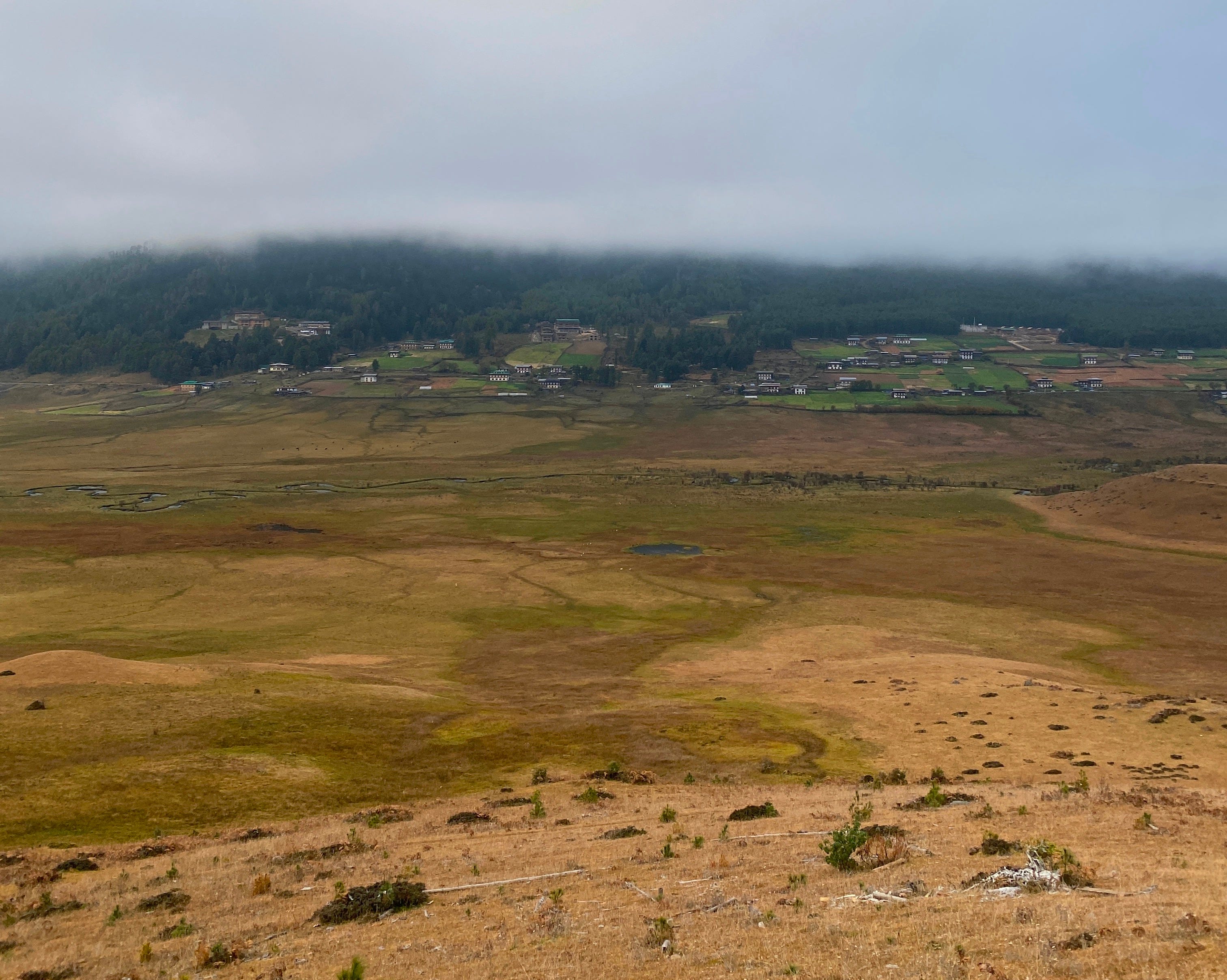
In Bhutan, a guide brought me to a bird blind to watch a flock of black-necked cranes in the valley below. I watched them for about a minute and a half and then spent the rest of the time wondering what the appropriate amount of time should pass before one tells the guide you’ve seen enough.
Maybe I’m doing it all wrong or have completely missed the point, but to enjoy birding, it seems to me you have to:
A) Enjoy actively searching for things
and/or
B) Enjoy sitting/standing there and watching something for a while
I tend to find pleasure in passively looking. Walking down a street, just gazing around at buildings, seeing what pops out. Hiking and letting the view that unfurls at the top as a sensory experience.
Whether it’s a piece of art, that same mountain view, or, yes, birds, I also find it very hard to look at something for an extended period of time. It’s a shame, but I’m very much an “okay, I’ve seen it, next!” type of person.
I love seeing wildlife, and birds are no exception. Spotting bald eagles scavenging the shallows of a beach in Vancouver was a highlight of a recent trip. And birding seems wonderful. It’s given hope for many of us that travel can have a positive impact on the environment. Destinations that want to attract birders need to be concerned with conservation and restoration of wildlife habitats. And on an individual level, I’m sure it provides a healthy and almost meditative way of passing time and connecting with nature.
But I won’t be turning my kitchen into an avian observatory or traipsing around with binoculars.
Yet.
DEPARTMENT OF GRIEVANCES

Mere days after my column on the original designs for Penn Station, new ones were leaked. I updated the post on Substack, but alas, it meant the email version was quickly out of date. Now the leaked plans have become official, and as I noted in the update, I don’t hate them. There’s nothing ground-breaking or inspiring about them, but they’re not embarrassing.

I really enjoy it when somebody writes in to tell me they think I’ve gotten something wrong. That’s in part because I enjoy discussion, but also, selfishly, if I am wrong, I’d rather know than keep repeating something wrong! A couple of months ago, I wrote about ominous signs of a softening in American tourism numbers to Europe and how that might affect places like Spain, Greece, Portugal, and others. In a blistering fury of missives explaining how much I overestimated American tourism’s effect on these economies, the individual noted that, given all the issues in the Middle East, Spain was the most likely beneficiary of rerouted tourism. And that person was right! The BBC has a report this week titled: “Spain’s visitor numbers hit new highs as tourists avoid Middle East.” In it, the BBC reports that expectations for a softening of Spanish tourism are long gone, and now another massive year is coming.
Spain isn’t the only “winner” in the Middle East crisis. While the region as a whole saw a 14% decline in visits, Egypt saw a 16% increase.
There’s something a little sad about once mighty government buildings in London being turned into hotels one by one. First it was the Old War Office into a Raffles, and now it’s the Admiralty Arch as a Waldorf Astoria. I’m not terribly invested in the fate of the British Empire, but it’s quite the symbol.
CBP (the agency that controls and staffs the U.S. border) keeps missing the forest for the trees. The disappointing and time-consuming part about Global Entry wasn’t using the kiosk to scan my face; it was that even after doing so, I still had to queue to talk to an officer. Its latest innovation—tossing the kiosks and using facial recognition tech to capture you as you walk in the line—doesn’t solve that! You’ll still have to go and talk to an agent, which is something the UK, the EU, Mexico, and others have all done away with.
Ugh, nearly every bit of airline news just makes it clear the heyday of reward programs is over. This time, it’s Alaska Airlines, which is not only hiking fees on award redemptions with partner airlines but also won’t award points on Saver Fares. And Hawaiian Airlines is getting rid of free meals in Economy.
Unless, of course, we’re talking about the airline experience for wealthier people. Their bit of good news? Linate Airport is everybody’s airport of choice for Milan. It’s shockingly quick to the city center, whereas Malpensa is a nightmare. However, Linate has a perimeter rule, meaning that the flights into it are regional, not international. But Italy is considering lifting that rule for flights that are entirely premium passengers. Which would certainly be a boon for La Compagnie, the all-premium airline!
It looks like hotels in World Cup host cities aren’t making their money off the event by having full occupancy, but rather jacking up the prices on the few rooms being sold.
Things might not be as bad at Ritz Carlton’s yachts as that FT piece made it seem…
There is perhaps no building that better encapsulates the struggle between trying to be current and preservation—and what lessons, if any, should come when something goes wrong—than the Tour Montparnasse. (The classic joke goes something like the best view of Paris is from the top of the Tour Montparnasse, because it’s the only place you can’t see the Tour Montparnasse.) That tower of black glass glowering over the left bank of Paris looms large not just in the physical world, but in how 20th century Paris developed. If the tower had been a hit, one could easily imagine a very different Paris today, one in which some chunks of it were rapidly given over to skyscrapers. Alas, it was not, and its stench stifled any desires for a more vertical (i.e., modern) central Paris. To traditionalists, like the author of this piece in The Spectator, the lesson is essentially to never attempt anything like that again. Leave Paris alone! And anywhere else with a whiff of history. But I think that’s the wrong lesson, and I don’t want to force Parisians to live in what is essentially a museum because of my need for Paris to always look a certain way.
Texas as the next wine destination, who knew?! The U.S. had its best year ever at the World Wine Awards, and one standout was Texas, leading CNN to write, “in the evolving wine landscape of 2026, grape cognoscenti are as likely to be planning their next vineyard adventure to Texas or Essex as to Bordeaux or Veneto.”
The list of changes that came with an EU overhaul of passenger rights is extensive and worth reading through, but one that I can definitely get behind is not being charged for fixing spelling errors in your name!
Venice’s new mayor is pushing for its daily entrance fee to jump all the way to … 50 euros!
This rant in the FT about how Harry Potter ruined so much of Great Britain’s great sights is really, really bad. From the holier-than-thou paragraph on how the author and her child would never read such rubbish, to the gobsmackingly broad brush used to overstate the number of places affected, it’s atrocious. Can’t believe this was run in 2026, especially since there are far worse culprits of overtourism.
Pricey airport overhauls aren’t just bad because of how wasteful they are. As I mentioned the other week, they’re also one of the things pinching low-cost airlines and making the business model untenable. Now JetBlue is reducing its presence at Newark and LaGuardia airports, in part because of the high costs of operating there after expensive renovations.
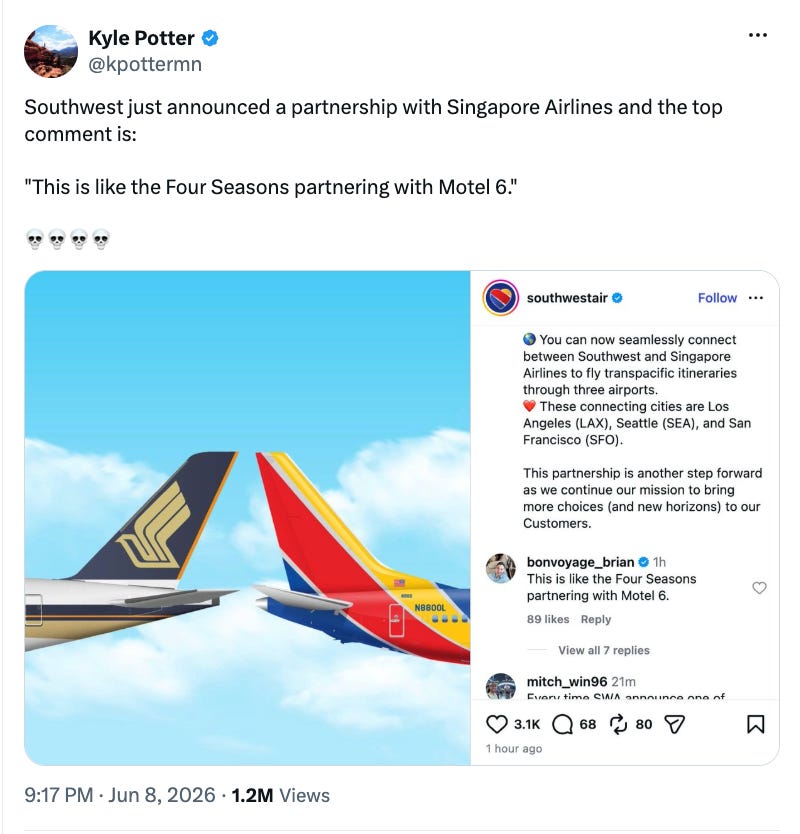
I am befuddled by the Southwest partnership with Singapore Airlines. Then again, I don’t know how the airline’s existing partnerships with Condor, IcelandAir, Turkish Airlines, All Nippon, and more are going. But I did find this post funny:
So much fuss has been made about podcaster Steven Bartlett’s little riff from nearly a year ago about drinking that I am reluctant to add to the pile on. My instinct is to roll my eyes at all this optimization and productivity obsession. I feel sorry for them, in a way. But so heavy has been the pile-on—the latest being Jemima Kelly in the FT—that I’m drifting the other way. There has to be some middle ground that recognizes that the optimization crowd is missing out on living, but also the flaw in having a culture in which drinking is often the only way we know how to socialize and create a setting that will be “memorable.” So many of the comments I’ve seen have honed in on travel as an area in which the optimizers are really missing out. Now, I do love a long, silly wine-soaked lunch while traveling. But I also think there’s something to be said for finding ways to experience a place without all the drinking.
STORIES I LOVED OR WISH I’D DONE
I love travel, but not traveling. I gorge myself upon a destination, but the romance of getting there is lost on me. I want fast, efficient, and useful train travel in the U.S., but I have no love for many of our current routes, and there’s a long list of things I’d rather do than sit on a train for more than four hours. The same goes for flying, driving, and any other means of transport with the exception of walking. That said, when in a plane taking off, I do often catch myself marveling at this feat that stands apart from almost anything else we’ve been able to do en masse as humans. It’s really incredible that I can be shot around the world in this metal tube. So I loved David Graham’s reminder in The Atlantic that we should savor plane travel much more than we do.
India remains one of the most special countries I’ve ever visited. It is a place so unlike anywhere else, which is a rare feat in our ever-flattening world. I’m dying to go back and am constantly compiling inspiration for where I might want to go. The latest is a column from Sam Dalrymple (son of William Dalrymple) titled “When Bengal was the Richest Place in the World.” In it, Dalrymple takes us into a district in Bengal called Hooghly. It’s filled with history, but the photos alone convinced me I want to go there!
When I studied abroad in Italy, I got pretty tired of churches. They were always a big part of any city tour we went on, and after a while, they kind of blended together. I no longer revolt at first mention of touring one, and many of my favorite architectural experiences have taken place in their hallowed halls. But I don’t orient my planning around them. But I am drawn to stories about people traveling in ways I don’t, so I was charmed by this Times story on the author’s favorite European cathedrals that declared, “like many of us, in a new city I head straight for the cathedral.” Even better? I’ve only been to one on the list!
I’ll always be a sucker for an origin story, and this Washington Post one on the DoubleTree cookie is a fun read. (Also, it made me feel better about being somebody who goes back for way more than just one cookie.)
This BBC story about the places around the world trying to get delisted from the UNESCO World Heritage List because of all the tourism issues it brings!
I would religiously read a newspaper column on how to party in your late 30s and 40s, so I think the FT should make this one about how to party in NYC like you’re 44 a regular thing.
TRAVEL INDUSTRY NEWS
A beach in Sardinia has banned umbrellas for all over the age of 10 and under 65 to prevent crowds
The expansion of Crystal Bridges—doubling its footprint—is open
The first Qantas Project Sunrise route, connecting Sydney with London, will launch in October 2027
Canyon Ranch Austin is now open for reservations